
How do you keep a fund-raising campaign on track? By being well organized, constantly monitoring progress, and informing all campaign participants of that progress. The very reason for the pyramidal structure of a campaign committee is to simplify management. In the best of circumstances, the pyramid is constructed so that no person supervises more than five people. (To maintain this limit is why we sometimes add campaign and divisional co-chairs.)
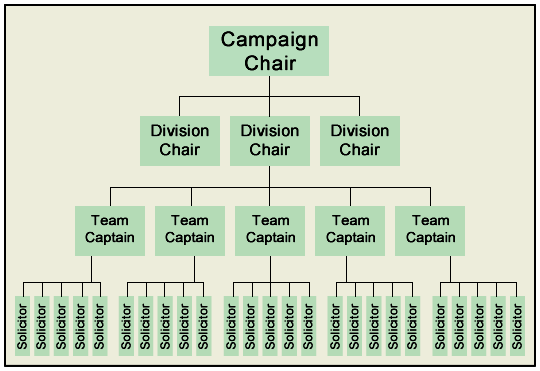
The campaign pyramid
Managing even the largest campaigns then becomes a matter of monitoring the progress of a limited number of small hierarchical units. Team captains track the efforts of solicitors, divisional chairs make sure that captains are on top of their teams, and the campaign chair keeps tabs on the divisions. However, this system works only if information moves upward quickly.
You can’t fix a problem in a campaign unless you know there is a problem.
The best way to make sure that information is being shared is to schedule monthly progress meetings .Attendees know they will be expected to report on their area of responsibility—what has been done, who has been contacted, how much money has been raised. The monthly progress meeting gives the campaign leaders a deadline by which they need to have their houses in order.
It is unlikely that you would reconvene at these progress meetings everyone who attended the kick off meeting. The logistics are just too cumbersome. Unless the campaign leadership is an especially large group, the ideal progress meeting consists of the campaign chair, divisional chairs, team captains, the organization’s development person, and the development consultant, if one is being used. In really large campaigns or in ones where some divisions have a great many teams, it may be better to have the division chairs meet independently with their team captains rather than include so many participants in an overall meeting.
A couple of days before a meeting, team captains should submit written campaign tracking and progress reports to the division chairs. Then the day before a meeting, the division chairs consolidate those reports and turn them over to the campaign chair.
Conducting The Meeting
The first item on the agenda of a progress meeting is an update from the campaign chair based on the reports she or he has received from the division chairs. This update details how much money has been raised and reports on major gifts. Next follows an assessment of the campaign’s progress—the real business of the meeting. How does the money raised stack up against what was expected from the donors? How many donors have given less than their rated level—and how much less? Which past donors expected to give to this campaign have been lost altogether? After adding the dollars raised so far to the amount projected to be received from the remaining prospects, how much money will the campaign raise? Will the goal be achieved? A written report of the foregoing should be passed out to all following the meeting.
The campaign chair’s written report on overall and divisional progress should also be sent to campaign participants who did not attend a progress meeting, including solicitors. I find that a campaign newsletter or email report is the best vehicle for distributing information for the duration of the campaign. At the very least, these communications should be published shortly after each progress meeting. Special editions are a great way to announce major gifts and events. A campaign newsletter or an email report is not the New York Times. Keep it simple, on a timely basis. A single sheet printed on two sides is fine, and the less one must scroll down an email, the better. If you have more news, adding more maybe necessary. Be sure to get these reports into the volunteers’ hands. They need to know that campaign management is on top of things and that progress is being made.
The Best Meeting “Climate”
To me, most important aspect of such campaign progress meetings is to know that substance is what really counts. Time is short. You have busy people who want to hear what is what, and not very much else. Full disclosure, just the facts, and results they can understand. Not a grim and tight lipped approach, to be sure, but they come for “business,” and that is what they should get. On the other hand, too much of a “health and happiness” atmosphere can obscure the facts of the progress (or lack), regarding how the campaign is coming along.
There are two things that you do not want to do at a progress meeting. Do not create a competitive atmosphere among divisions and among teams within a division. The campaign succeeds when every division, team, and solicitor succeeds. People should be invested in the campaign, not in their particular team or division. You should also avoid calling attention publicly to a person’s failure to perform. Remember, these are volunteers. Just as we would not shame a prospective donor for failing to meet our expectations, we should not humiliate a volunteer whose efforts have fallen short.
You want volunteers leaving a progress meeting with a clear understanding of where the campaign stands and a renewed commitment to get the job done. If the campaign is on track, getting that commitment isn’t hard. But if the money booked to date added to the unreported gifts total ends up somewhere south of the goal, then it’s time for reassessment and adjustment.
To learn more about how FundRaiser can help with your Reports
Register for a free tour of the software